Most Sydney commuters have a complicated relationship with their cars. The vehicle that gets you from St Marys to the CBD each morning, or from Castle Hill to Macquarie Park and back, is genuinely one of the most load-bearing parts of a busy working week. When it needs attention, you need to deal with it, and you need to do it without the car being out of action for longer than necessary.
So when the service interval comes up, or something starts sounding wrong, the question most Sydney drivers face is the same one: do I take it to a workshop and work around their schedule, or do I look at a mobile mechanic who comes to me?
Understanding What Each Option Actually Involves for Sydney Drivers
Before comparing costs or time, it helps to be precise about what you’re actually comparing.
A traditional workshop is a fixed-location facility where your car is brought in, queued, and serviced or repaired by mechanics working across multiple vehicles at the same time. The workshop has hoists, specialised equipment, and a team of staff. You drop the car off, you leave, and you collect it when it’s done. In some cases, that’s same-day. In others, it’s not.
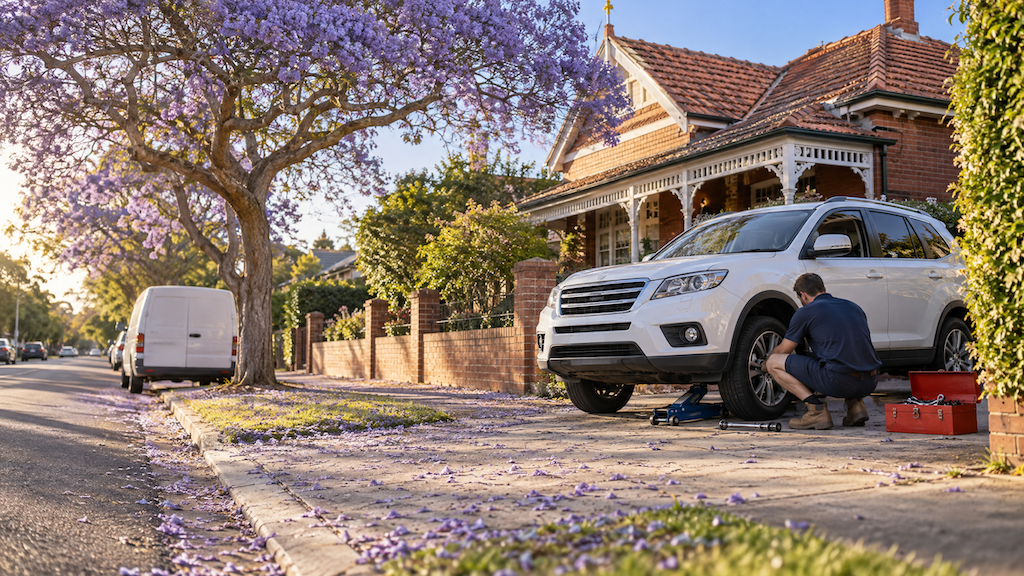
A mobile mechanic operates from a fully equipped service van and comes to wherever your car is located. Your home, your workplace carpark, a street address. The work is done on-site, usually while you get on with your day. The mechanic brings tools, diagnostic equipment, and parts for the job at hand.
The quality of work and the qualifications required are the same in both cases. A mobile mechanic doing a logbook service is using the same procedure, the same oil specifications, and the same inspection checklist as a workshop mechanic. What changes is everything around the job itself.
The Real Cost Comparison: Mobile Mechanic Pricing vs Workshop Pricing in Sydney
Cost is usually the first thing people want to understand, and it’s also the area where the most misconceptions exist. The common assumption is that mobile mechanics charge a premium for coming to you. In Sydney’s market, that’s generally not accurate.
Workshop pricing is driven by overhead. A workshop in a Sydney suburb carries rent or mortgage costs on the premises, equipment financing, front-of-house staff wages, and the general costs of running a multi-person operation. Those costs get built into labour rates. A mobile mechanic’s overhead is primarily the van, equipment, and their own time. Lower overhead typically means more competitive pricing.
Where workshops do have an advantage is on parts procurement. High-volume workshops buy parts in bulk and may have preferred supplier pricing that lowers parts costs. A good mobile mechanic has solid parts supplier relationships too, but the volume may be lower. So it roughly evens out.
The more interesting cost comparison is the total cost of each option, not just the invoice.
When you take a car to a workshop, consider what’s not on the invoice:
- Ridesharing or taxi costs to get yourself home after dropping the car, and back to collect it
- Public transport time if you live somewhere with limited options
- Potential lost work time if the workshop schedule doesn’t align with yours
- The cost of a hire car if the work takes longer than expected
- Parking costs if the workshop is in a location where parking isn’t free
None of those costs appear on the mechanic’s invoice, but they’re real. For an inner-city Sydney driver taking the car to a workshop in a different suburb, two Uber trips easily add to the total cost of the service. For someone in the Hills District or the where public transport can be limited, that number goes up.
Mobile mechanic pricing, by contrast, is largely what it is. The mechanic comes to you, the work is done, and the invoice reflects the labour and parts. No transport costs. No logistics overhead on your end.
Time Comparison: How Much of Your Day Does Each Option Actually Take?
This is where the difference becomes most concrete for Sydney commuters, and it’s worth being specific rather than vague about it.
A typical workshop visit for a standard logbook service works roughly like this. You drop the car off, ideally first thing in the morning. You arrange alternative transport, or you wait. Assuming the service goes smoothly and nothing unexpected is found, you might get a call by midday to say the car is ready. You then need to get back to the workshop to collect it. Total time from your day: the morning, plus whatever time it takes to get back and collect, plus the mental bandwidth of coordinating all of it.
In Sydney traffic, the logistics alone add up. If you live in Baulkham Hills and the workshop is in Parramatta, getting there and back in peak hour is not a 20-minute round trip. It’s closer to an hour or more, depending on timing. And if the service uncovers something that needs attention and the car needs to stay another day, you’re doing all of that again tomorrow.
A mobile mechanic visit for the same service looks like this. You book a time, the mechanic arrives at your home or workplace at the agreed time, they do the service while you’re working or getting on with your day, and they’re done in two to three hours for a standard service. You haven’t gone anywhere. You haven’t arranged alternative transport. You’ve just continued with your day.
The time saving for a typical Sydney commuter isn’t marginal. It’s the difference between losing a morning and not losing anything at all.
Here’s a direct comparison for a standard logbook service:
| Factor | Mobile Mechanic | Traditional Workshop |
| Where the work happens | At your home, work, or roadside | You drive or tow the car to them |
| Transport needed? | No | Yes, to and from the workshop |
| Typical wait time | Job done while you work or rest | Half day to full day minimum |
| Scheduling flexibility | Evenings, weekends, same-day | Mostly Mon-Fri business hours |
| Pricing vs dealership | Generally lower overhead, competitive rates | Higher overhead, especially dealerships |
| Transparency of work | You can observe the job in person | Work done offsite, phone updates only |
| Logbook servicing | Yes, warranty-compliant | Yes |
| Major mechanical work | Limited by hoist requirements | Full range with workshop equipment |
| Best suited for | Routine servicing, diagnostics, brakes, batteries | Complex repairs, major engine or transmission work |
Stress Comparison: Which Option Creates Less Friction for a Busy Sydney Schedule?
Cost and time are measurable. Stress is harder to quantify but just as real for someone managing a full working week, a family, and a Sydney commute.
The stress of workshop servicing comes from a few places. There’s the scheduling friction: finding a time that works, getting the car there, arranging your own transport, and building your day around someone else’s workflow. There’s the uncertainty: not knowing exactly when the car will be ready, getting a call at 2pm saying it needs an extra hour, or finding out mid-job that something else needs attention and the quote has changed. And there’s the follow-up logistics: getting back to collect the car, usually in a window that doesn’t perfectly align with when you’re free.
None of this is the fault of the workshop. It’s just the nature of a fixed-location service model. You’re fitting yourself around their operation.
Mobile servicing inverts that. The mechanic fits around you. You choose the location, you choose the time window, and the mechanic shows up at your end. If something unexpected is found, they can show you directly, explain it clearly, and you make the decision on the spot without a phone call to someone you’ve never met.
For parents with school pickups, for people working from home who can’t easily disappear for half a day, and for anyone whose schedule runs on a tight clock, the stress difference is significant. In most cases, a mobile service requires you to do exactly one thing: be somewhere your car can be accessed. That’s it.
Where Traditional Workshops Still Have the Edge Over Mobile Mechanics
This is an honest comparison, so it has to include where workshops genuinely have an advantage. And there are situations where a workshop is the right call.
The most obvious is major mechanical work that requires a hoist. Anything underneath the car, full exhaust replacement, complex suspension work, gearbox or transmission jobs, these require the car to be lifted off the ground safely. Mobile mechanics work without a hoist, which limits what can be done on the underside of the vehicle. A mobile mechanic will tell you this directly if the job is outside what they can do on-site.
Workshops also have an advantage for jobs that require specialist equipment that can’t practically be transported in a van. Some suspension alignment work, for example, requires a wheel alignment bay with fixed equipment. Certain air conditioning regas procedures use machines that are workshop-installed rather than portable.
If your car needs major engine work, a rebuild, or significant structural repair, a workshop is the right place for it. Mobile mechanics are built for the work that most cars need most of the time, not every possible repair scenario.
So the practical answer for most Sydney commuters is this: mobile mechanics handle the majority of what your car needs on a regular basis, and they handle it more conveniently and often more affordably. For the less common, more complex jobs, a workshop is the right tool. Many good mobile mechanics will refer you to a trusted workshop for those jobs rather than attempt something outside their practical scope.
Which Sydney Drivers Benefit Most from Mobile Mechanic Servicing?
Professionals working from home get an obvious advantage. The car gets serviced while you’re at your desk, and you lose no productive time at all. For this group, mobile servicing is almost always the superior option for routine maintenance.
Commuters who travel significant distances to work and rely heavily on their vehicle also benefit significantly. The disruption of taking a car out of service for a day, when it’s the foundation of a daily commute, has real flow-on effects. Mobile servicing keeps the disruption essentially zero.
Parents, particularly those managing school runs and after-school commitments, find mobile servicing fits naturally into the day. A service booked for the morning while kids are at school means the car is ready by the time the school run starts, and nothing in between was disrupted.
People in Sydney suburbs with limited public transport options, outer western suburbs, and parts of the Hills District also get a disproportionate benefit. For these drivers, getting to and from a workshop without a car is genuinely difficult, not just inconvenient. Mobile servicing removes the problem entirely.
How to Choose the Right Mobile Mechanic in Sydney
Choosing a mobile mechanic follows the same logic as choosing any tradesperson. Qualifications, transparency, and reputation matter more than anything else.
A few things worth checking before you book:
- Verified qualifications: the mechanic should be a licensed automotive technician, not just someone with experience
- Clear pricing upfront: any reputable mobile mechanic will give you a quote before starting work, not after
- Transparent communication: they should be able to explain what they’re doing and why, in plain language
- Logbook servicing capability: if warranty compliance matters to you, confirm they can stamp and maintain your logbook correctly
- Reviews and track record: recent reviews from Sydney customers give you a sense of reliability and how they handle unexpected findings
Also, and this is worth emphasising, a good mobile mechanic will tell you when a job is outside what they can do on-site. That honesty is a feature, not a limitation. It means you’re not getting substandard work done in a situation that needed workshop equipment.
The Mr Tune Approach to Mobile Servicing Across Sydney
At Mr Tune, we work with Sydney commuters every day who’ve made the switch from workshop servicing and find the difference in their week immediately noticeable. Less time lost, less to coordinate, and a mechanic who can actually show you what was done rather than summarise it over the phone.
We cover Sydney and handle logbook servicing, general servicing, brakes, diagnostics, batteries, and more. Pricing is transparent before any work begins, and if something comes up during a job that changes the scope, we explain it to you directly and you decide what happens next. No surprises on the invoice.
If a job is outside what we can do on-site, we’ll tell you that honestly and point you in the right direction. That’s the whole approach.
Frequently Asked Questions: Mobile Mechanic vs Workshop in Sydney
Mr Tune is a Sydney-based mobile mechanic. We work with clients across Sydney to ensure your car runs as smoothly as possible. Get in touch with us to see how we can help you.