Logbook servicing is one of those terms used often in the car industry but rarely gets explained properly. Most new car owners are told they need it without being told exactly what it is, why it matters, or what happens if they skip it. And a common point of confusion: can a mobile mechanic actually do it, or does it have to go to a dealership?
This guide covers everything Sydney car owners need to know about logbook servicing, from what the service actually involves and why the schedule exists, to the legal framework that protects your right to have it done wherever you choose.
What Logbook Servicing Actually Is and Why It Exists
A logbook service is a scheduled maintenance service performed at specific intervals, defined by either the vehicle’s age or odometer reading, whichever comes first. The service follows a checklist prescribed by the vehicle manufacturer and is recorded in the vehicle’s logbook with a stamp, signature, and the date and odometer reading.
The logbook itself is a physical record that travels with the car. It documents the entire service history, which matters for two reasons. First, it demonstrates to the manufacturer that the car has been maintained according to their schedule, which is the basis of warranty compliance. Second, it represents significant value when selling the car. A full service history in a stamped logbook is one of the most reliable indicators of how a car has been maintained and commands a measurably higher resale price.
The intervals vary by manufacturer. Some vehicles use 10,000km or 6-month intervals, whichever comes first. Others use 15,000km or 12-month intervals. Some newer models use variable interval servicing, where an onboard computer calculates the service interval based on actual driving conditions. Your logbook and owner’s manual will specify what is relevant to your vehicle.
How Logbook Servicing Protects Your New Car Warranty in Australia
This is the most legally important aspect of logbook servicing for new car owners, and it’s an area where a lot of misinformation still circulates.
Under the Competition and Consumer Act 2010, Australian Consumer Law protects new car buyers from being forced to use dealer servicing to maintain their warranty. Manufacturers cannot void a warranty simply because the car was serviced by an independent mechanic rather than a dealership, provided the service was performed by a qualified mechanic using appropriate parts and was documented correctly.
This protection has been in place for years, but many dealers still imply, and occasionally state outright, that the warranty requires dealer servicing. That claim is not legally accurate in Australia. You are entitled to have your logbook service performed by any qualified mechanic, including a mobile mechanic, without affecting your statutory warranty.
The conditions for warranty protection are:
- The mechanic performing the service must be qualified and licensed
- Parts used must meet the manufacturer’s specifications, or be of equivalent quality
- The service must follow the manufacturer’s logbook checklist for that interval
- The logbook must be correctly stamped with date, odometer, and mechanic’s details
All four of these conditions can be met by a qualified mobile mechanic. The location of the service, your driveway rather than a dealership bay, is not a warranty-relevant factor under Australian law.
What a Logbook Service Actually Includes at Each Interval
The specific items covered in a logbook service depend on the manufacturer’s schedule and the interval number. Early intervals tend to be lighter, covering the basics. Later intervals, typically around 60,000km and 100,000km, are more comprehensive and may include items like spark plugs, timing belts, and coolant flushes.
A standard logbook service typically includes:
- Engine oil and oil filter replacement: This is the core of every service interval. Oil quality degrades over time and distance, losing its protective properties.
- Air filter inspection and replacement: A clogged air filter reduces engine performance and fuel economy
- Cabin air filter inspection: Affects air quality inside the vehicle and air conditioning performance
- Brake inspection: Pad thickness, rotor condition, and hydraulic system check
- Fluid level checks: Coolant, brake fluid, power steering fluid, and windscreen washer fluid
- Tyre condition and pressure: Tread depth and inflation across all four tyres, including the spare
- Battery condition test: Voltage and load test to assess battery health and remaining life
- Visual inspection: Under the bonnet and underneath for leaks, worn components, and anything unusual
- Lights check: All lighting, exterior and interior
- Logbook stamp: Recording the date, odometer, and mechanic’s details
At higher mileage intervals, additional items may include spark plug replacement, transmission fluid service, coolant flush, fuel system cleaning, and timing belt or chain inspection. Your logbook specifies what applies at each specific interval.
Why Sydney Drivers Are Choosing Mobile Mechanics for Logbook Services
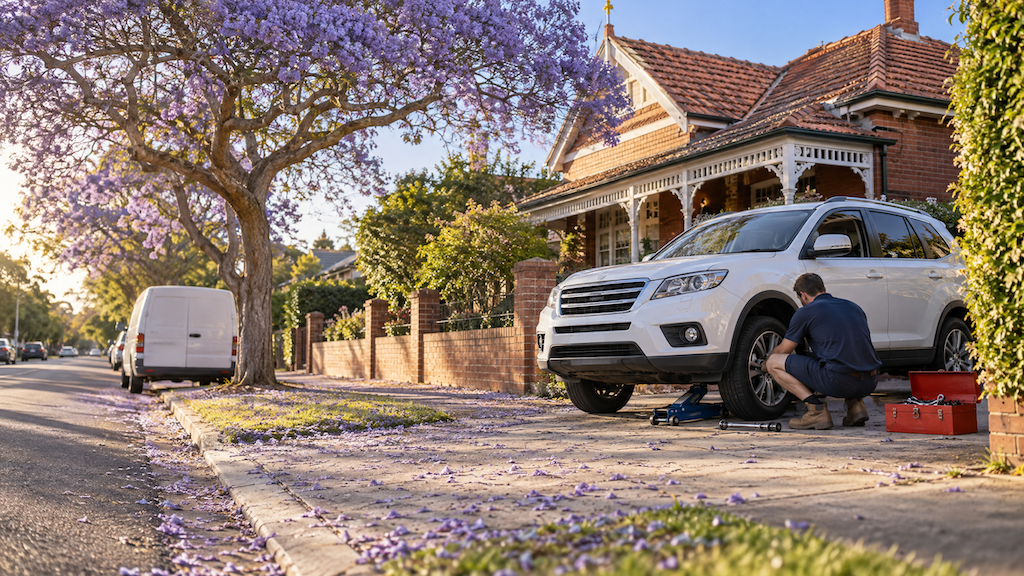
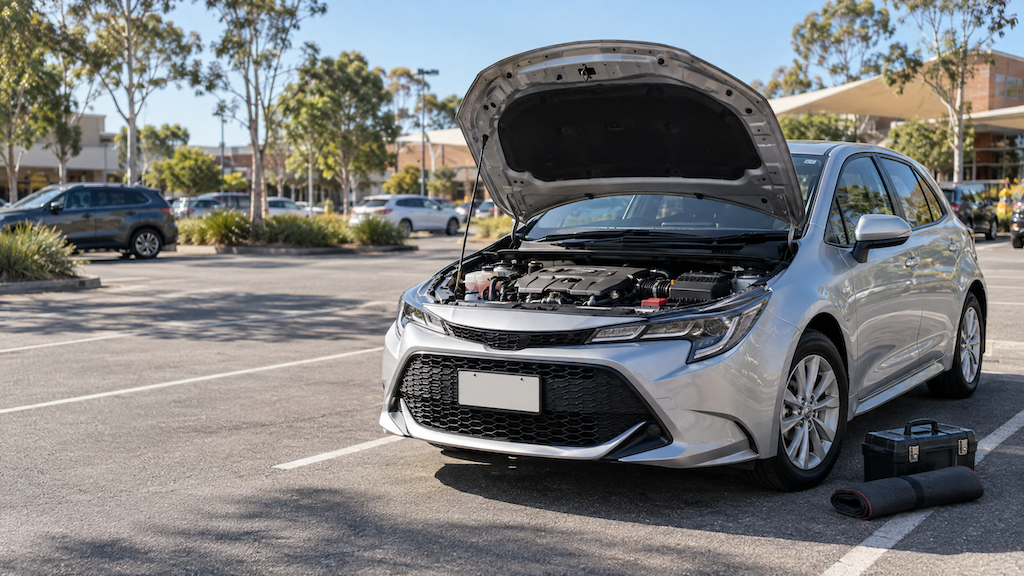
The mechanics of a logbook service don’t require a workshop hoist. Oil and filter changes, fluid checks and top-ups, filter replacements, battery testing, brake inspections, and visual inspections can all be performed in a driveway or car park with professional-grade mobile equipment.
For Sydney commuters, the convenience is significant. A logbook service booked with a mobile mechanic means the car gets serviced at home, at work, or wherever it’s parked. You don’t lose a morning driving the car somewhere, arranging transport back, and then reversing the process when it’s ready. The service takes the same amount of time, but it doesn’t cost any of your own time to support it logistically.
For new car owners, particularly, this removes the pressure of fitting workshop hours into a working week. The car needs its service by 10,000km or 6 months, and that deadline doesn’t care whether you had a spare morning in the last month. Mobile logbook servicing gives you back the scheduling flexibility to book when it suits you, not when a workshop has a gap.
How Often Your Vehicle Needs a Logbook Service in Sydney Conditions
The manufacturer’s specified interval is the minimum. Sydney’s driving conditions sometimes make earlier attention worthwhile.
Sydney urban driving involves many short trips, stop-start traffic, and infrequent extended highway runs. Short trips are harder on engine oil than longer ones because the engine doesn’t fully warm up, which means water and condensation that build up during cold starts don’t fully evaporate from the oil. Over time, this degrades oil quality faster than the same kilometre count on a highway.
If your driving is predominantly short suburban trips in Sydney, some mechanics recommend not pushing to the outer edge of the kilometre or time interval. If you hit the time limit, say, six months before the kilometre limit, follow the time limit and book the service.
What Happens If You Miss a Logbook Service Interval
Missing a logbook service by a modest amount, a few weeks or a few hundred kilometres, is unlikely to cause mechanical damage if the car is otherwise running well. However, it does create a gap in the service record that appears in the logbook history.
More concerning is the warranty position. If a fault develops that falls under the manufacturer’s warranty and the vehicle has a missed or significantly overdue service, the manufacturer may investigate whether the lack of servicing contributed to the fault. In those cases, a gap in the logbook can complicate a warranty claim.
For cars no longer under manufacturer warranty, missing a service interval has no warranty consequences, but still has practical ones. Engine oil that’s been running too long loses its protective properties and accelerates internal wear. The cumulative effect of consistently missed or late services is shortened engine life.
If you’ve let a service lapse, the right answer is to book it now and have it done properly; don’t wait for the next interval. Complete the overdue service, document it correctly and move forward.
Book Your Sydney Logbook Service With Mr Tune
At Mr Tune, we perform logbook services across Sydney for all makes and models. We follow the manufacturer’s service schedule for each interval, use correct-specification parts and oils, and stamp and complete your logbook accurately. Your warranty is fully protected.
We come to your home, your workplace, or wherever your car is based. For most standard logbook services, the job is done in two to three hours without disrupting your day. Book when it suits you, not when a workshop has an opening.
Frequently Asked Questions About Logbook Servicing in Sydney
What happens if I have lost my car’s logbook? A lost logbook doesn’t erase the vehicle’s service history, but it does lose the physical record of it. For vehicles still under manufacturer warranty, contact the dealership network or manufacturer directly. They typically maintain digital records of services performed at their dealerships. For independent mechanic services, receipts and invoices can sometimes substitute. Replacement logbooks can be obtained through dealerships or some vehicle registries, though they start blank from the point of replacement.
Does my car require a logbook service or just a general service, and what is the difference? A logbook service follows the specific manufacturer-prescribed checklist for your vehicle at a specific interval and gets recorded in the logbook. A general service is less formally defined and typically covers the basics without being tied to a specific manufacturer’s schedule or documented in the logbook. If your car is under manufacturer warranty or within the age range where logbook history affects resale value, a logbook service is the right choice. General services suit older vehicles where the logbook history is already complete or less relevant to value.
Can I skip a logbook service interval and double up at the next one? Not effectively. Each logbook service interval has a time limit and a kilometre limit. Engine oil, for example, degrades over time, regardless of how far the car has been driven. If the 6-month or 12-month interval arrives, the oil needs to be changed even if the kilometre threshold hasn’t been reached. Skipping an interval and doubling up at the next one means the oil has been in the engine for twice the intended duration, which is not ideal for internal engine condition.
What’s the difference between time-based and distance-based service intervals? Most manufacturers specify both a time limit and a kilometre limit, with the instruction to service at whichever comes first. The time limit accounts for oil degradation over time regardless of usage. The distance limit accounts for accumulated wear and contamination from driving. Sydney drivers with low annual kilometres often hit the time limit before the distance limit. High-kilometre commuters typically hit the distance limit first. Either way, the interval that comes first is the one that triggers the service.
Do newer cars with variable service intervals still need regular logbook servicing? Yes. Variable service interval systems, also called service reminder systems or flexible service intervals, adjust the mileage between services based on how the car is being driven. The car still displays a service due indicator when the system calculates its time. Following that indicator constitutes the logbook service for that interval. It’s not an indication that servicing is optional, just that the interval is calculated dynamically rather than fixed at a set kilometre value.
Does a logbook service cover the same checks as the manufacturer’s full inspection schedule? A correctly performed logbook service follows the manufacturer’s checklist for that specific interval, which includes all the items the manufacturer specifies at that point in the service schedule. Some items only appear on the checklist at specific intervals, spark plugs and timing belts, for example, and won’t be covered at every service. The logbook itself lists what’s included at each service number. A reputable mechanic will follow that specific schedule rather than a generic checklist.
Mr Tune is a Sydney-based mobile mechanic. We work with clients across Sydney to ensure your car runs as smoothly as possible. Get in touch with us to see how we can help you.